
|
Sylvania Hi-Spot ES50 - The First GU10 Lamp |
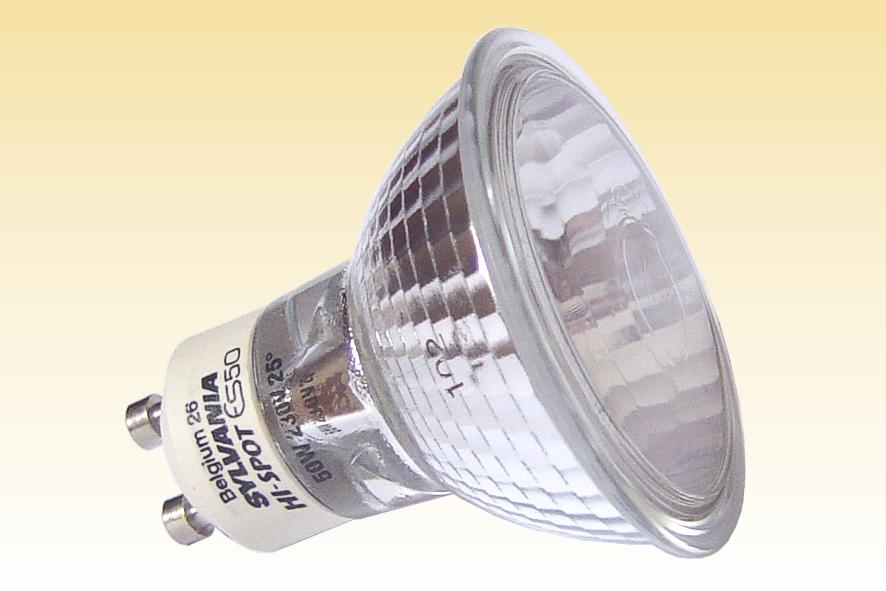
It was made possible thanks to the miniature W-shaped filament, in which a 230-240V coil measuring some 25mm long is folded into a tiny halogen capsule small enough to be focussed in the 50mm reflector. The capsule is made from aluminosilicate hard glass instead of the usual quartz, this permitting the glass-to-metal seals to be made with molybdenum wires instead of the usual flat foils. There is space to seal five wires through the seal, and this is what permitted the W-shape filament in such a short capsule. A parallel invention was the GU10 base, having a positive twist-and-lock action - a major improvement over the fragile 12V pins and based on the earlier GU7 base of GE-Thorn.
GU10 lamps quickly achieved dominance in retail markets, despite being much less efficient than 12V types. Whereas 12V 50W lamps operate at about 20lm/W, the first 50W GU10 capsules achieved only 10.5lm/W. The larger filament also leads to inferior beam control, with a luminous intensity typically 3 times less than an equivalent wattage 12V lamp.
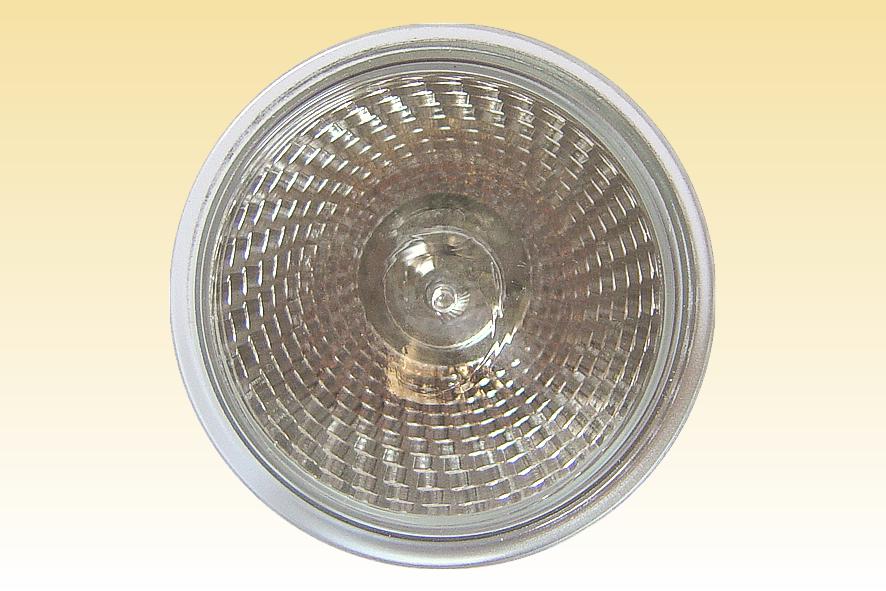

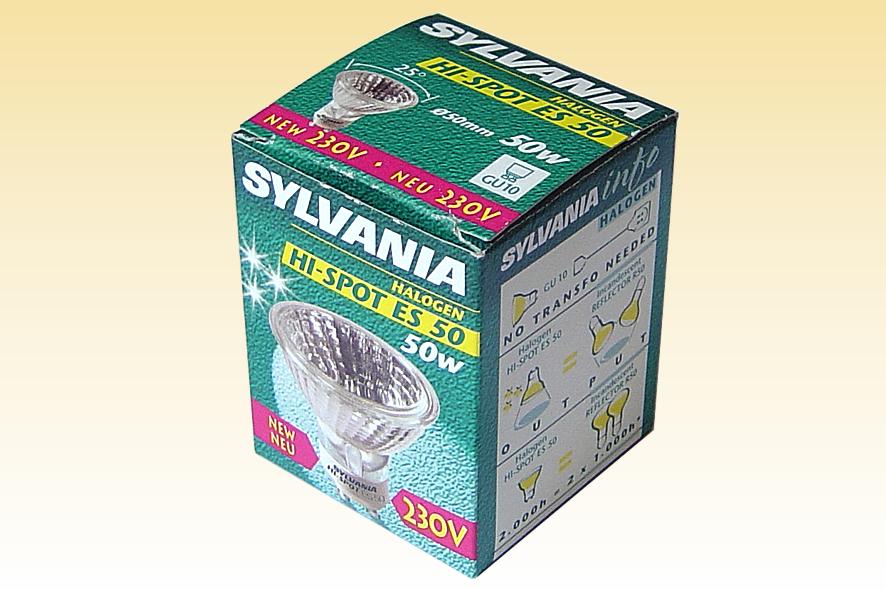
| Manufacturer: | Sylvania Lighting International | |
| Lamp Power: | 50 Watts | |
| Lamp Voltage: | 230 Volts | |
| Lamp Current: | 0.217 Amperes | |
| Cap Type: | GU10 | Ni plated + Steatite |
| Bulb Type: | MR-50 | MR-16 in eighths/inch |
| Bulb Finish: | Aluminised reflector | Clear lens |
| Filament Type: | CC-13 | Coiled-Coil W-shape |
| Atmosphere: | 25% Nitrogen in Krypton | HBr-SiH4-PH3 |
| Luminous Flux: | 525 lm | |
| Luminous Efficacy: | 10.5 lm/W | |
| Peak Intensity: | 1,150 cd | |
| Beam Distribution: | 25° | to 50% peak |
| Colour Temperature & CRI: | CCT: 2700K | CRI: Ra 100 |
| Chromaticity Co-ordinates: | CCx: 0.460 | CCy: 0.411 |
| Rated Lifetime: | 2000 hours | to 50% survival |
| Burning Position: | Universal | |
| Max. Overall Length: | 55 ± 2 mm | 2¼" |
| Light Centre Length: | N/A | |
| Factory: | Tienen | Belgium |
| Date of Manufacture: | December 1997 | Date Code 24 |
| Original / Present Value: | EUR €7.20 (2004) | GB £4.97 (2008) |

