
|
Monsanto MV1 - The First Successful Red LED |
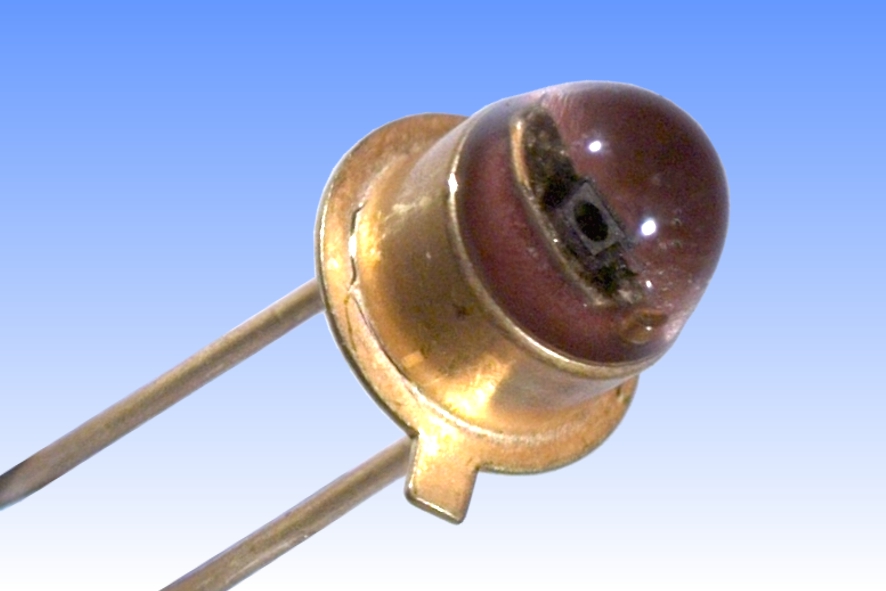
This situation changed in 1968 when Monsanto, the manufacturer of the raw Gallium Arsenide Phosphide semiconductor material, established its own high volume production of both alphanumeric displays as well as discrete LED lamps. The type MV1 featured on this page was the first of the company's solid state lamps, and is widely regarded as being the world's first commercial visible light LED.
The heart of the device is the semiconducting die, which consists of a GaAs substrate having a GaAsP top layer which forms the light emitting component. This layer was applied by the vapour phase epitaxy process developed at GE. Electrical connection to the lower side of the die is effected by its direct contact with the gold plated anvil shaped formation at the inner end of the cathode lead. The upper side of the die is provided with a metallised contact, probably of an inert metal such as platinum or rhodium, featuring a hole at its centre through which light is emitted. Current to the metallisation is carried via a fine wire of colourless metal, suspected to be platinum, which is welded to the anode lead. The assembly is packaged in a standard TO-5 header normally employed for transistors of the era, and sealed with a clear acrylic dome of high refractive index which aids light extraction and protects the die.


| Manufacturer: | Monsanto | |
| Lamp Voltage: | 1.65 Volts | |
| Lamp Current: | 20 mA Nominal | 50 mA Maximum |
| Lamp Power: | 33 mW Nominal | 83 mW Maximum |
| Cap Type: | Gold Plated Wires | Ø 0.0175" x 0.1" Pitch |
| Bulb Type: | TO-5 transistor | |
| Bulb Finish: | Clear acrylic | |
| Die Chemistry: | GaAsP | |
| Luminous Flux: | ||
| Luminous Efficacy: | ||
| Peak Intensity: | 0.5 millicandela | |
| Beam Distribution: | 120 degrees | to half-peak |
| Peak Wavelength: | 655 nm | |
| Colour Temperature & CRI: | CCT: N/A | CRI: N/A |
| Chromaticity Co-ordinates: | CCx: 0.721 | CCy: 0.278 |
| Rated Lifetime: | ||
| Burning Position: | Universal | |
| Overall Length: | ||
| Light Centre Length: | ||
| Factory: | Palo Alto, CA | U.S.A. |
| Date of Manufacture: | Circa 1970 | |
| Original / Present Value: | GB £1.00 (1969) | GB £12.30 (2008) |
