
|
Mazda MBM 40W Mercury Lamp for Coal Mines |

The lighting of mines is especially challenging due to the presence of fire damp, a mixture of flammable gases. This requires strict regulations on the use of electricity to avoid sparks and ignition at switches or poor contacts. A much safer form of lighting was pioneered by distributing power via compressed air, driving a small generator in each light fitting which could be turned on by operating an air valve. At first incandescent lamps were employed, but were not optimal due to their limited output and fragile nature.
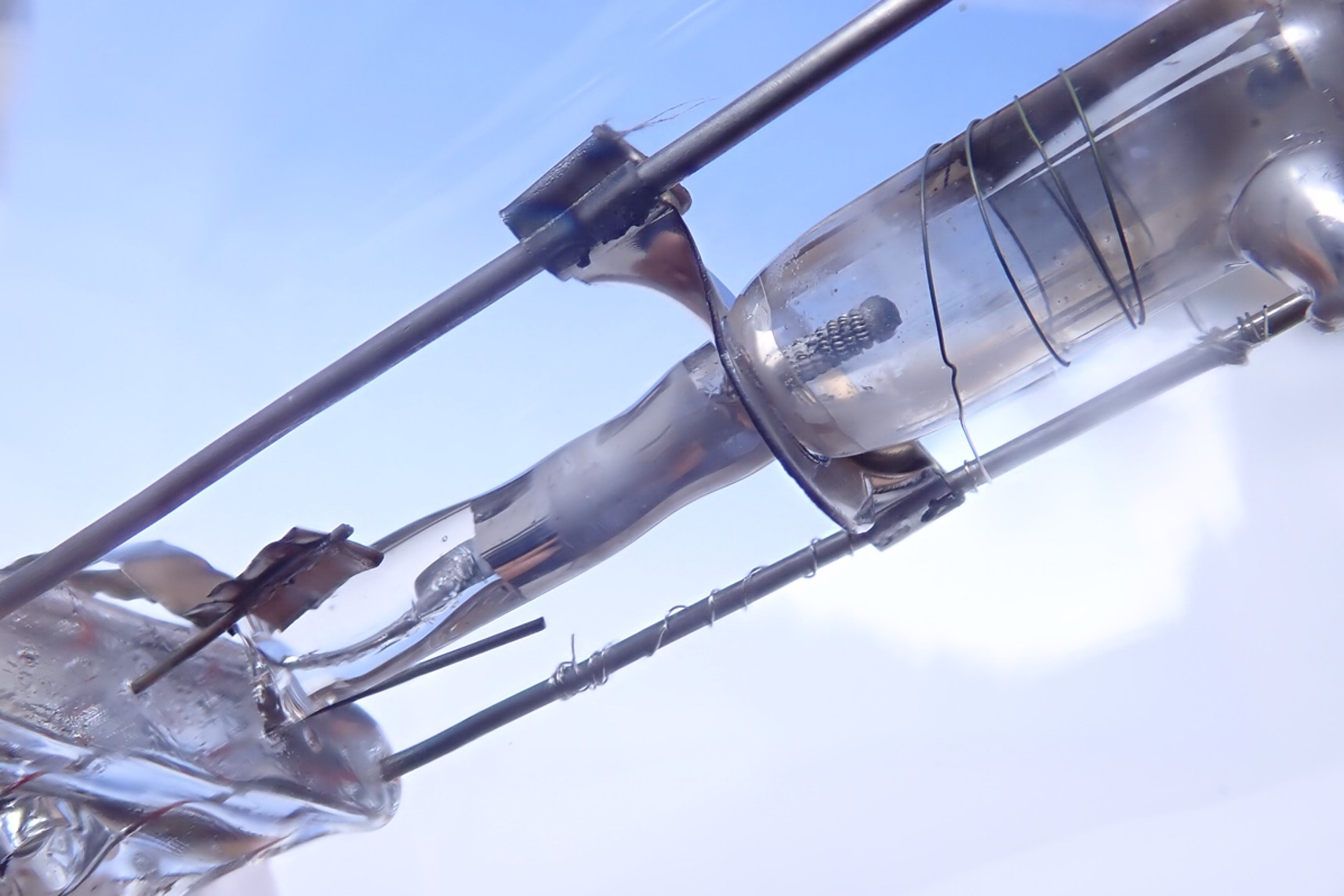
The development of this 40W type MBM mercury lamp enabled a major advance in both output and robustness. In a novel arrangement it was electrically ballasted by slightly modifying the windings of the AC generator. Unlike other mercury lamps this model does not contain the usual third auxiliary ignition electrode. The generator produced a 500Hz AC supply and at such high frequency, a capacitive antenna consisting of a few turns of wire around the arc tube proved satisfactory, greatly simplifying lamp construction.
This original lamp employs an ST-shape radio valve bulb, the domed top allowing secure mounting of the inner structure. Later examples adopted a standard ellipsoidal shape outer bulb and a much more resilient arc tube mounting structure. Such lamps were widely used in British coal mines until the 1990s, when they were made obsolete by more efficient fluorescent lamps in special explosion-proof luminaires.



| Manufacturer: | The British Thomson-Houston Co. Ltd. | |
| Lamp Power: | 40 Watts | |
| Lamp Current: | 0.59 - 0.45 Amps | |
| Lamp Voltage: | 80-105 Volts | |
| Cap Type: | B22d-3/31x30 | Ni plated brass + vitrite |
| Bulb Finish: | Clear | Soda-lime glass |
| Bulb Type: | ST-54 | ST-17 in eighths/inch |
| Overall Length: | 120 mm | 4¾ inches |
| Light Centre Length: | 90 mm | 3½ inches |
| Arc Length | 11 mm | 0.43 inches |
| Electrodes: | Backwound thoriated | Double carbonate emitter |
| Inner / Outer Atmosphere: | Inner: Ar | Hg (12 atm.) | Outer: Ar-N2 0.5 bar |
| Luminous Flux: | 1,360lm(100hrs) 1000lm(750hrs) 800lm(1500hrs) | |
| Luminous Efficacy: | 34lm/W (100hrs) 25lm/W (750hrs) 20lm/W(1500hrs) | |
| Colour Temperature & CRI: | CCT: 6000K | CRI: Ra 16 |
| Chromaticity Co-ordinates: | CCx: 0.315 | CCx: 0.380 |
| Burning Position: | Vertical cap down | |
| Rated Lifetime: | 1,500 hours (to 50% survival) | |
| Warm-up / Re-strike Time: | 5 minutes | 5 minutes |
| Factory: | Rugby | England |
| Date of Manufacture: | June 1947 | Date Code: 66 |
| Original / Present Value: | Unknown | Unknown |

